

Hannibal Bank + Coiba National ParkPrivate Boat · Up to 4 Anglers
Two legendary fishing grounds, one private boat and a night on an island in between. Black marlin, cow-sized yellowfin tuna and the wild south of Coiba.
Hannibal Bank is the most famous offshore fishing spot in Panama, and this private charter takes you there the scenic way: through the wild south of Coiba National Park, with a night on an island in between.
You leave from our home dock at the Club Nautico de Veraguas in El Bongo, next door to Puerto Mutis, or we pick you up in Santa Catalina on the way. On day one you fish the deep drop-offs of Jicarita and Jicaron, the most remote islands of the park. You spend the night at Bahia Onda or Isla Simca, about an hour from the bank, so on day two your lines are in the water while the sun is still coming up. Want more? Add a third day and fish until about 1 pm before heading home.
Back in 1914, the USS Hannibal was taking depth soundings off Panama’s Pacific coast, getting ready for the opening of the Panama Canal. South of the Gulf of Chiriqui, the sounding line came up short: a huge underwater mesa, about five miles wide, rising from thousands of feet of ocean to some 120 feet below the surface. The Navy gave it the ship’s name, and anglers have been making the run out ever since.
The secret is the water. Cold, nutrient-rich currents hit the seamount and push up from the deep, the bait piles up, and the big predators follow. Its peaks also work as cleaning stations, where marlin and tuna line up to get groomed by smaller fish. Scientists have even found three new coral species on the bank.
Hannibal Bank is protected as a Special Marine Protection Zone together with Isla Montuosa, next to Coiba National Park, and the park’s own public use plan names the nautical club in El Bongo as a departure point for trips to the bank. In other words: this is our backyard.
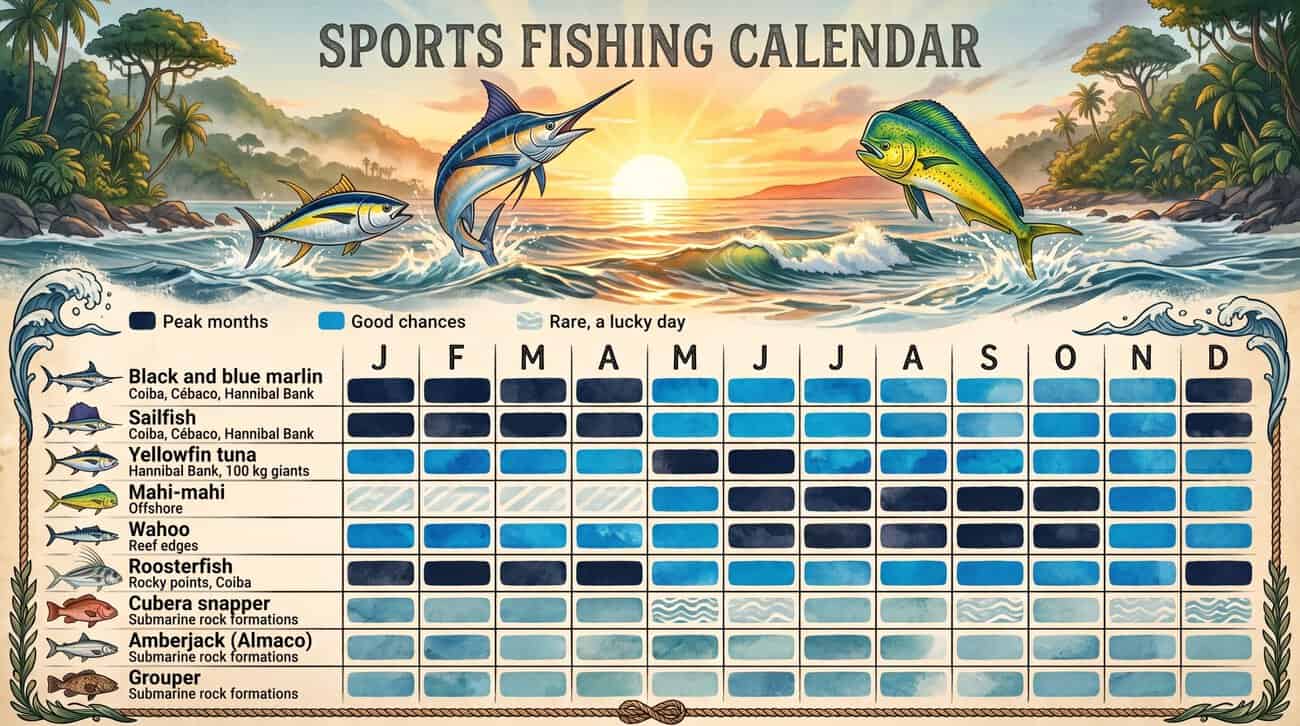
There’s no bad month at Hannibal Bank, just different targets. Nature calls the shots, so think of this as a forecast, not a promise. Chasing one species in particular? Tell us and we’ll help you pick your dates.
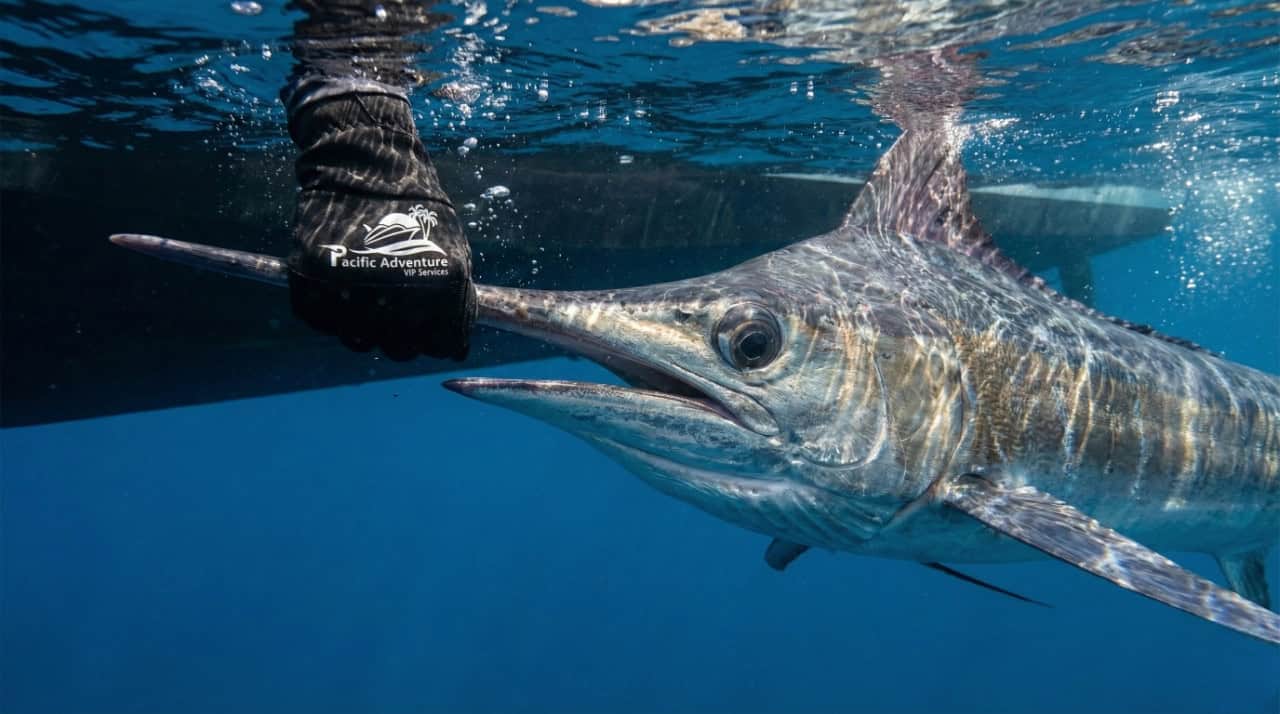
The main event, and the fish that made Hannibal Bank famous. Some fights last for hours.
The “cows”: yellowfin up to 100 kg (220 lb), plus tuna frenzies that make the water boil.
Billfish season, when a grand slam is on the table. Every billfish goes back to the water.
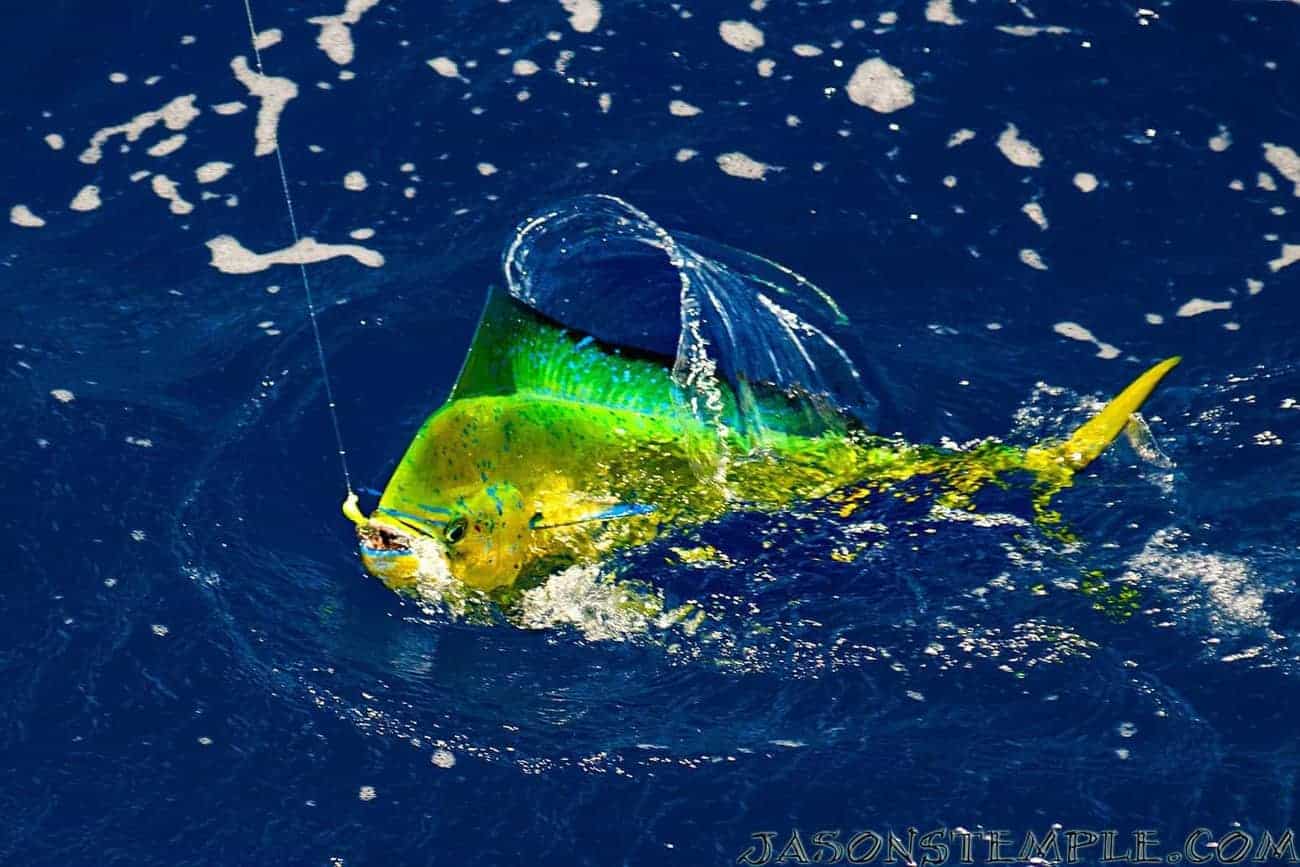
Dorado means “gold” in Spanish and mahi-mahi means “very strong” in Hawaiian. Both are spot on.
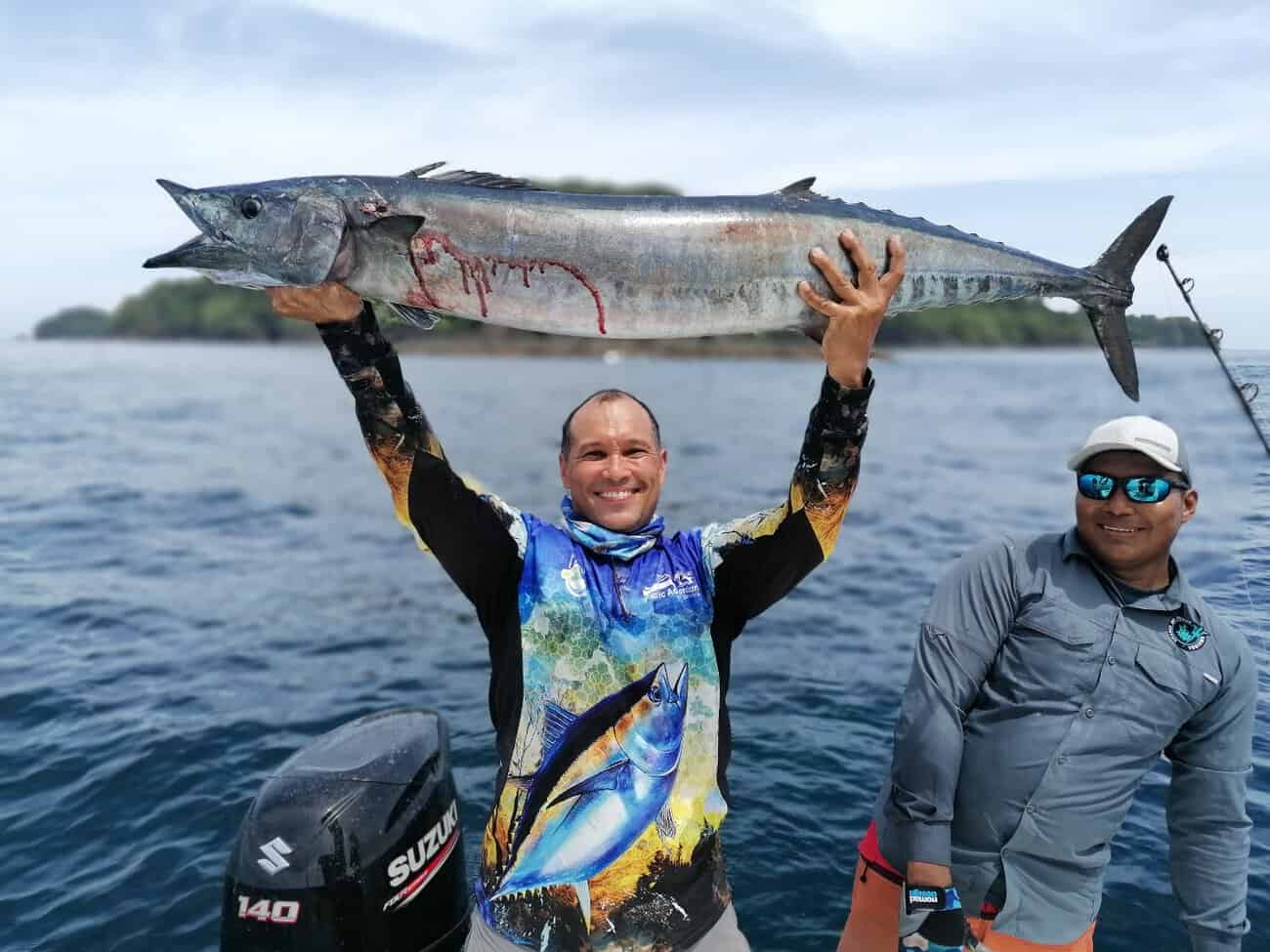
Lightning fast and great on the grill. A rainy season favorite: early mornings, trolling fast, are prime time.
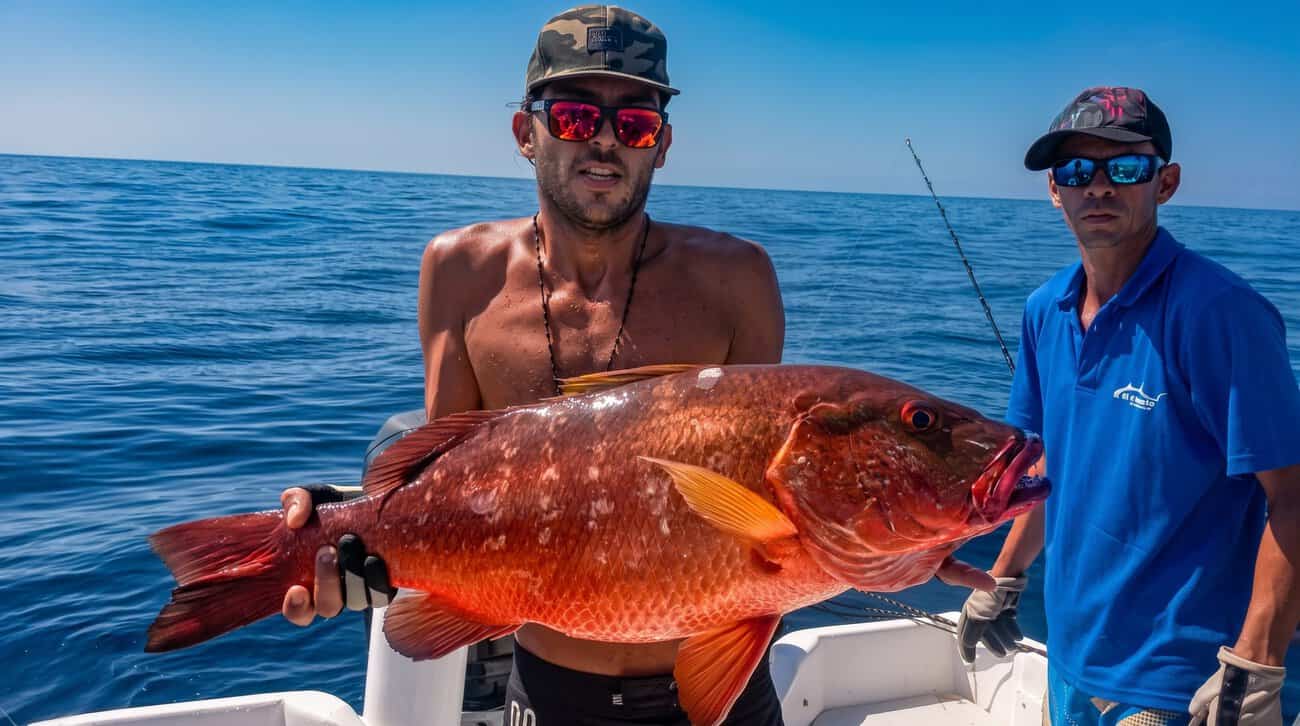
The island crew around Jicarita and Jicaron. Cubera snappers are protected and always go back.
Not just fishing? See our month-by-month wildlife calendar for whales, whale sharks and sea turtles too.
No experience needed. Your fishing captain walks you through every step, from the strike to the release.
Come in May or June, bring your fighting spirit, and let’s go find that frenzy.
Big game by day, a quiet island by night. The best of both worlds.
Same legendary bank, plus the wild drop-offs of Jicarita and Jicaron that most boats never see.
Your fishing captain rigs the gear, reads the water and coaches you through the fight. You just hold on tight and enjoy the ride. And if the ocean gets bumpy, the islands of Jicarita and Jicaron are our sheltered plan B.
Same legendary bank, a whole different trip.
Tell us your favorite technique when you book: trolling, live bait, popping or jigging. We bring full gear for all of them, but we like to rig the boat around the way you fish.
Marlin, sailfish and cubera snapper always go back to the water: it’s the law in Panama, and we wouldn’t have it any other way. Tuna and mahi-mahi grow fast and roam the open ocean, so we can whip up fresh sashimi right on board. Nothing tastes better than a dinner you fought for. We keep disposable plastics off the boat and bring every piece of trash back to the mainland, and part of your park fee goes to the Coiba Fund, which supports research and the communities around the park.
Long-sleeve sun shirt, a cap, polarized sunglasses, biodegradable sunscreen, a light raincoat, seasickness pills if you need them, and your physical passport in a waterproof case. Disposable plastics are banned in the park; bring your reusable water bottle.
Every morning your captains check the wind, the swell and the currents, and plan the day with you: where to catch bait, which peaks to work and how long to stay. Some days start slow and turn into the fight of your life; some days the tuna are boiling before breakfast. That’s Hannibal Bank: it makes you earn it, then hands you the fish of a lifetime.
Anglers know the drill: weather is part of the game out on the open ocean. If your captain decides it isn’t safe to go, we move your trip to a new date, usually the next day. Once you’re out, we adjust the route together to keep everyone safe.
New to the area? Read How to Get to Coiba.
Set with you. We usually leave El Bongo around 6:00 am and pick up Santa Catalina guests on the way around 7:00 am. On your last day we fish until about 1 pm, then head back to your departure point.
Two days get you to Hannibal Bank; three days let you fish it properly.
Day 1: El Bongo or Santa Catalina, fishing at Jicarita & Jicaron, night on a nearby island
Day 2: Full day at Hannibal Bank, another night on the island
Day 3: Fish the bank or the islands until about 1 pm, then back to port
Price: US$4,000 per boat, up to 4 anglers. Lodging and meals booked separately.
Plan Your Trip on WhatsApp
It’s a seamount at the southern edge of the Gulf of Chiriqui, on Panama’s Pacific coast, protected as a Special Marine Protection Zone together with Isla Montuosa, next to Coiba National Park. From our island bases at Bahia Onda or Isla Simca it’s about an hour by boat.
About 2 hours from El Bongo to Jicaron, or about 1 hour from Santa Catalina. From Bahia Onda or Isla Simca to Hannibal Bank, about 1 hour.
Not with us. It’s a long way out and back, so our trip is 2 days minimum and we recommend 3: you sleep close to the bank and spend your time fishing, not commuting.
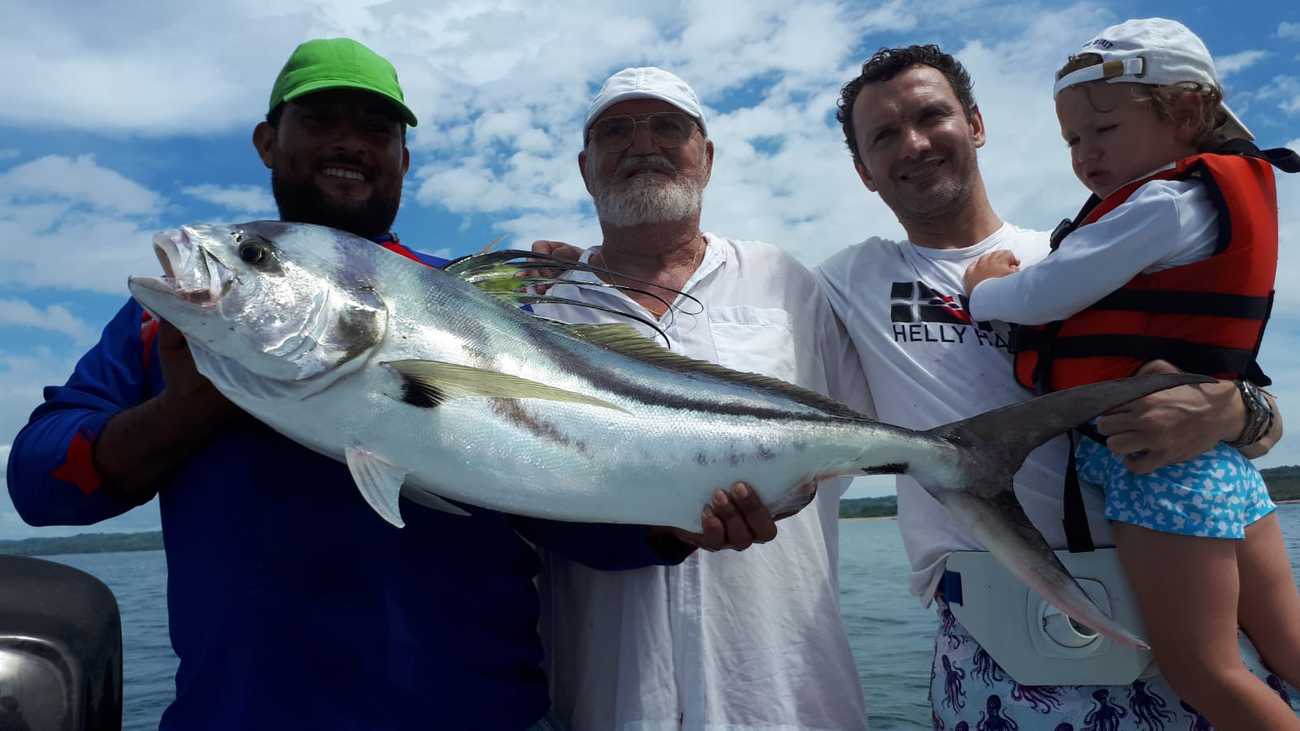
There’s no bad month. Billfish peak from December to March, cow-sized yellowfin tuna show up in May and June, and mahi-mahi and wahoo peak from June to October, and roosterfish from December to April. Tell us your target species and we’ll help you pick your dates.
$1,500 per boat per day, 2 days minimum, for up to 4 anglers: US$3,000 for the 2-day trip and US$4,000 for 3 days. It includes the boat captain, the fishing captain, full tackle, lures, live bait, your sport fishing license and the Coiba National Park fishing permit. Lodging, meals and the park entrance fee are not included.
You choose: Bahia Onda, simple and comfortable right by the sea; Isla Simca, an award-winning private island resort; or a partner hotel in Santa Catalina: Hotel Santa Catalina, Villa Coco, Bambuda or Catalina’s Hideaway. We book it for you.
Trolling, live bait, topwater popping and vertical jigging. We bring full gear for all of them and always ask which one you prefer.
Marlin, sailfish and cubera snapper are protected in Panama and always go back to the water. Tuna and mahi-mahi grow fast and roam the open ocean, so we can prepare fresh sashimi on board.
No extra paperwork: your sport fishing license from ARAP and the Coiba National Park fishing permit from MiAmbiente are both included in the price.
Up to 4 anglers, so everyone gets real time on the rod.
A covered mini yacht with a boat captain and a fishing captain, a cooler, water and ice. There’s no restroom on board.
Your safety comes first. If your captain decides it isn’t safe to go out, we move your trip to a new date, usually the next day, at no extra cost. Once the trip has started, nature can still change its mind; if it does, your captain adjusts the route, the timing or both with you. In that case we don’t offer refunds or new dates. For other changes, see our booking terms.
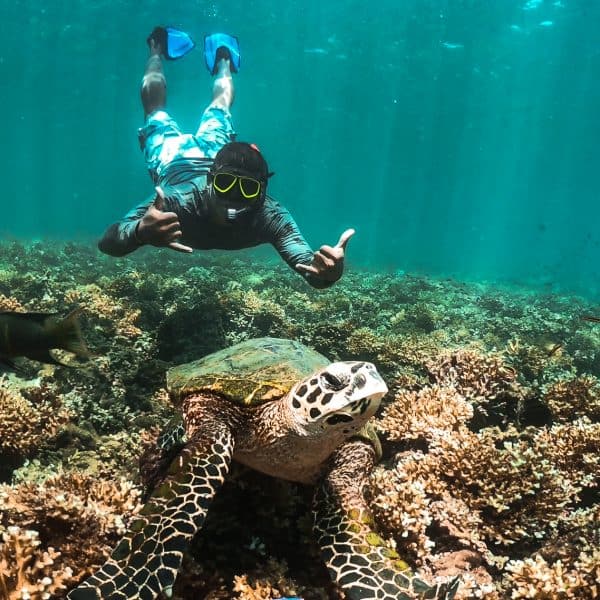
Absolutely. Add a day of snorkeling with sea turtles in Coiba National Park, whale watching from July to October, or a few lazy days in Santa Catalina. Tell us your plans and we’ll put it together.
We leave El Bongo around 6:00 am (about 2 hours to Jicaron) or pick you up in Santa Catalina around 7:00 am (about 1 hour). We catch live bait on the way, then fish the drop-offs of Jicarita and Jicaron for tuna, mahi-mahi, roosterfish, and snappers.
Settle in at Bahia Onda or Isla Simca, about an hour from Hannibal Bank. Sashimi from the day’s tuna, a cold drink and an early night.
Early start, bait in the tubes and a day working the peaks of the bank for black marlin, sailfish and yellowfin tuna. On a 2-day trip we fish until about 1 pm and head back to your departure point.
Another night on the island, then fish the bank or the islands until about 1 pm and head back to El Bongo or Santa Catalina.
Conditions change with the sea, the tide and the season, so your captains pick the spots each day. These are the regulars.
Type: Seamount with peaks near the surface
Depth: From thousands of feet up to about 120 ft
Targets: Black marlin, sailfish, yellowfin tuna, mahi-mahi and wahoo
Type: Offshore bank
Depth: Open water
Targets: Marlin, mahi-mahi and sailfish
Type: Rocky island with a 1930 lighthouse that guided ships to the Panama Canal
Depth: Deep water close to shore, right where the continental shelf ends
Targets: Tuna, mahi-mahi, sailfish and the big ones passing by
Type: Uninhabited island, 84% forest, steep rocky coast
Depth: Shallow reefs to deep drop-offs
Targets: Roosterfish, snappers, tuna and mahi-mahi
Type: Rocky point on the west coast of Coiba Island
Depth: Shallow reefs to rocky drop-offs
Targets: Roosterfish, snook and snappers
Type: Rocky points and reefs close to shore
Depth: Shallow
Targets: Inshore favorites like roosterfish and snappers
A simple, comfortable base right by the sea, close to the fishing grounds.
An award-winning private island resort near Coiba, for when only the best will do.
Hotel Santa Catalina, Villa Coco, Bambuda or Catalina’s Hideaway. We pick you up on the way.
Tell us your budget and your crew, and we’ll match you with the right base.