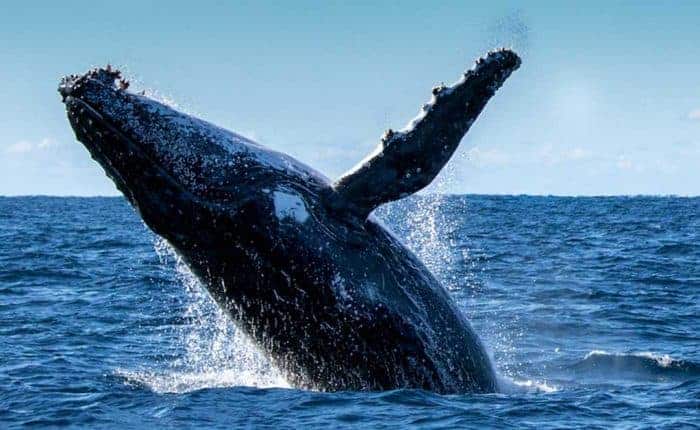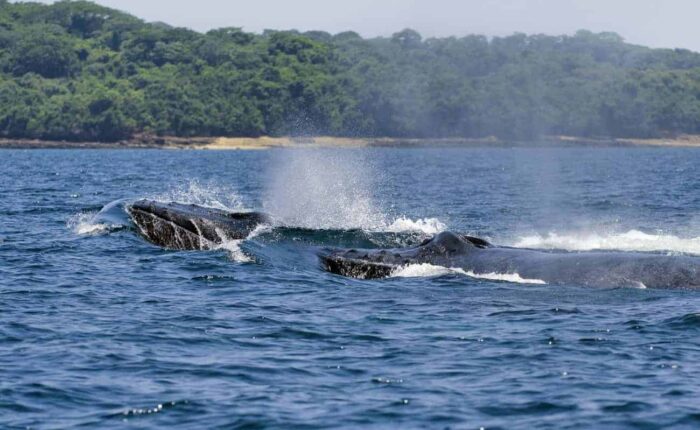


The humpback whales are just around the corner. Right now, as we are involved in our daily routines, the southern humpback whale population is making its way with determination toward the Panamanian Pacific. They must complete a grueling 8,000-kilometer journey. They have already left the icy currents of Antarctica behind, passed through the Chilean coast, crossed Peru, and are now traversing Ecuadorian waters, preparing to enter Colombia; for many of them, their final destination will be the warm waters of Panama. This turns our coasts into a celebration for those who enjoy watching these great mammals and the ideal place for responsible whale watching.
The young males, always going as the vanguard, will reach our shores long before the rest. In mid-July, we’ll see the first blowholes breaking the horizon. Pregnant females move at a different pace and will arrive a little later. This means that the best time to witness this natural show peaks during the months of August and September, although the stragglers continue swimming in Panamanian waters until mid-October.
Did You Know Electricity Saved Their Lives?
Just over a century ago, as night fell over the world’s great cities, streetlamps bathed the avenues in a soft, almost romantic glow. But do you know what fueled that light? Whale oil.
To keep those lights burning, we hunted them without mercy. We cornered them across every ocean on the planet, driving them to the very edge of extinction. We nearly silenced the seas forever, just to brighten our streets.
But sometimes, miracles arrive in unexpected ways.
One day, electricity surged through the cities. The moment the first lightbulbs flickered on, the need for whale oil vanished, and the massive hunts stopped making money. Ironically, the same human progress that threatened nature became the exact force that stopped the harpoons.
Around that same time, something broke our hearts. Scientists recorded their underwater songs and brought their voices to the surface. The entire world listened to their melodies for the first time. We suddenly realized our massive, devastating mistake: we weren’t hunting sea monsters or floating tanks of fuel. We were slaughtering incredibly intelligent beings. Mothers who fiercely love their babies. Entire families that feel deep pain and pure empathy.
You probably feel a heavy sadness right now for all the damage we caused, mixed with an overwhelming joy that we stopped just in time. Today, every time you watch a humpback whale breach and take a free breath in the open ocean, you are looking at a survivor. Somehow, I like to think they forgave us. And witnessing that miracle right in front of your eyes automatically makes you their guardian for the rest of your life.
The Longest Mammal Migration on Earth Is Happening Right Now
For them, traveling to Panama isn’t just a tourist whim; it’s a matter of life and death. They are looking for the warmth of our waters. Some come to find mates, but the vast majority do so to give birth. This biological process involves a physical sacrifice that borders on the impossible.
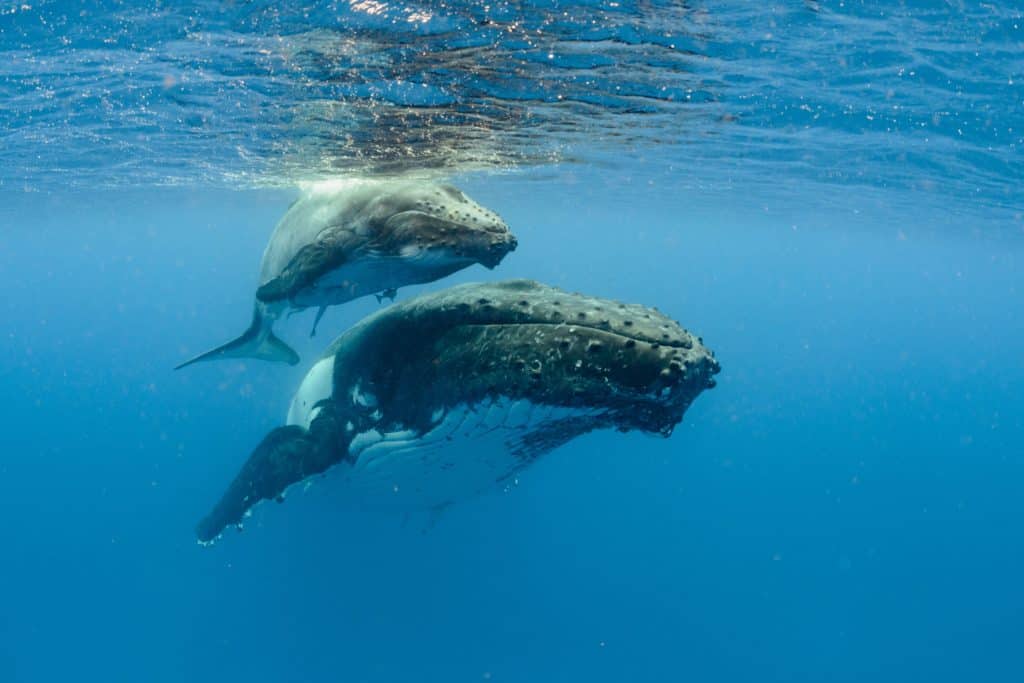
Watching a mother swimming alongside her newborn calf is a beautiful moment, but behind that tender image lies a reality that few are aware of. These mothers haven’t eaten anything since leaving the icy waters of the south. Absolutely nothing. They survive by burning the body fat they accumulated during their months in Antarctica. From that same fat reserve, they produce between 100 and 200 liters of milk daily during the first months of the calf’s life.
The result? This diet, which is extremely rich in nutrients, allows the calf to gain between 40 and 45 kilograms a day (equivalent to the total weight of an 8-year-old child). However, the toll on the mother is immense. By the time they finally begin their return journey south, they are swimming in a near-death state. They have lost more than a third of their body weight, exceeding 10 tons of weight loss. They leave all their vitality in our waters so that their offspring can gain the strength necessary to survive the journey back to the feeding grounds.
That extreme exhaustion is just one of the constant dangers they face in the ocean. The open sea is unforgiving and hides relentless threats. Orcas, highly intelligent and organized hunters, represent their greatest natural nightmare; they attack in groups, seeking to separate the mother from her calf without any mercy. As if nature weren’t enough, the whales must dodge heavy commercial shipping traffic and survive the invisible danger posed by the vast industrial fishing nets floating adrift.
Best Locations for Whale Watching in Panama
You can spot these giants all along Panama’s Pacific coast, from the Darién region on the border with Colombia to Punta Burica on the border with Costa Rica. The open ocean stretches out before you. In addition, the Pearl Islands and the Secas Islands in the Gulf of Chiriquí serve as the main gathering spots. They love these areas.
However, we work in the most strategic locations. First, the coast of Pedasi. The biggest advantage of this spot? It’s one of the most accessible places in the country to watch them. With a little luck, you can sit on the sand and watch the jumps right from the beach. And so you can sleep like a king or queen, the Pedasi Paradise Hotel is at your disposal—the best base in the area to unwind after a day of sun and saltwater.
On the other side of the country, off the coast of Veraguas, we cruised directly to Mariato, Cébaco Island, Santa Catalina, and Coiba National Park (a UNESCO World Heritage Site). Of all these options, Coiba holds the undisputed title of my favorite sanctuary.
We designed this experience so you can enjoy a “two for the price of one” tour. We combine responsible whale watching with exclusive time for snorkeling. If luck is on your side underwater, you’ll hear the males’ songs vibrating in your chest as the sound travels for miles in the depths. We always include a stop at at least one remote island. We give you free time to explore exotic white-sand beaches and turquoise waters, immersing yourself in colorful coral communities teeming with life. Throughout the tour, we may have the opportunity to encounter on the water other residents such as dolphins, sea turtles, and hundreds of tropical fish in mind-blowing colors.
Amazing Facts About Humpback Whales
Spending time with them in their natural habitat allows us to witness incredible things. Here are some interesting facts that will change the way you see them:
- Identity in the tail: Imagine having your ID card or a painted fingerprint on your back. That’s how a humpback whale’s tail fin works. Every pattern of pigmentation and scarring is unique in the world.
- Massive size: An adult female can grow up to 16 meters long (about five stories high) and weigh up to 40 tons (about seven African elephants). Seeing an animal that size leap completely out of the water makes you feel both tiny and lucky at the same time.
- A heart that can withstand anything: They have a massive heart that weighs about 200 kilograms (the weight of two adults). When they dive deep, they can slow their heart rate to conserve oxygen.
- The underwater concert: Only the males compose and sing complex melodies that travel dozens of kilometers underwater. They sing songs—divided into rhythmic, complex verses—that can last up to 20 minutes and repeat them in chorus for hours. What’s incredible is that the rhythm evolves over time, and it has been shown that different populations exchange “musical hits” when they encounter each other in the ocean.
- Complex emotional intelligence: They possess a special type of brain cell, called fusiform neurons, associated with complex emotional and social processing. They feel empathy, communicate, and form deep bonds. Their brain is three times larger than a human’s, and its structure is more complex, suggesting that they are clearly more intelligent than we are. And they have possessed this capacity for reasoning for over 30 million years.
- Use of tools and cooperation: They have developed the “bubble net” technique. A coordinated group blows bubbles in a circle to corral the fish, while others make sounds to guide them to the surface. This requires advanced planning, synchronization, and communication.

Why is Whale Watching Important in Panama?
Whale watching in Panama is a natural and transformative experience. But it goes far beyond just a personal adventure. Ethical tourism acts as a powerful economic lifeline for Panama’s coastal communities. When locals see that these giants bring prosperity to their shores, they become the fiercest defenders of the ocean. It creates a perfect cycle: your visit sustains the towns, and the towns protect the whales, ensuring every encounter is handled with absolute responsibility. Nature follows its own script, which is why it always surprises us, but it does have its own distinct rhythms. We understand those rhythms. With Pacific Adventure Tours, we’ll take you on a respectful and memorable journey to experience this wonder firsthand.