


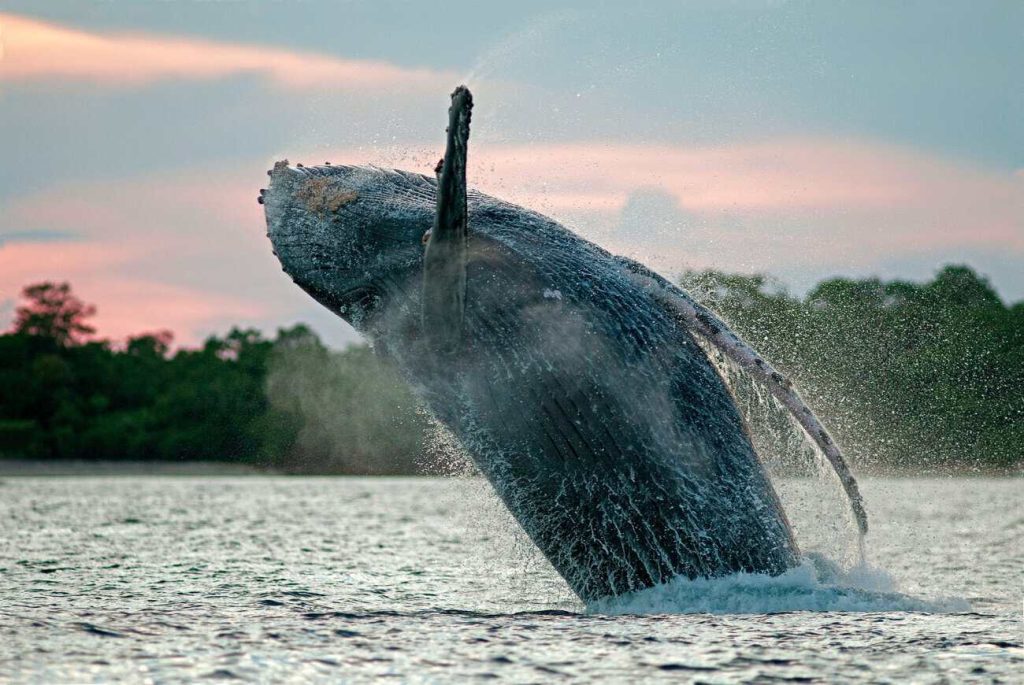
The first question always comes before the whale is fully out of the water.
“Was that water?” Then: “Why did it jump?” “Is the little one its baby?” “Can it see us?” By the time the tail disappears, half the boat is asking something and the other half is too busy staring to talk.
After years of answering them on deck, these are the humpback whale facts people want to know most. Some answers surprised even us.
What Is a Humpback Whale?
A humpback whale (Megaptera novaeangliae) is a baleen whale found in every ocean. It feeds in cold polar waters and travels to warm tropical seas to mate and give birth. In Panama, humpback whales arrive from July to October from Antarctica, and a few come from the North Pacific early in the year. For dates and places, see our whale watching guide to Panama.

1. Why Is It Called a Humpback Whale?
The humpback whale got its name from the way it dives, not from a real hump. Before going deep, it arches its back high out of the water, and that curve is what the old whalers saw from their ships.
Its scientific name tells the rest of the story. Megaptera means “big wings”, for its giant pectoral fins, and novaeangliae means “of New England”, where European whalers first described it.
2. How Big Is a Humpback Whale?
A humpback whale is about the size of a city bus: up to 16 meters long and around 30 tons, with the biggest females reaching 40. In humpbacks, the females are larger than the males.
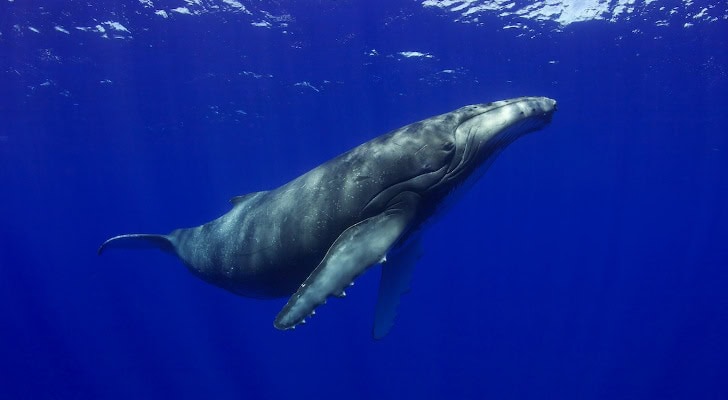
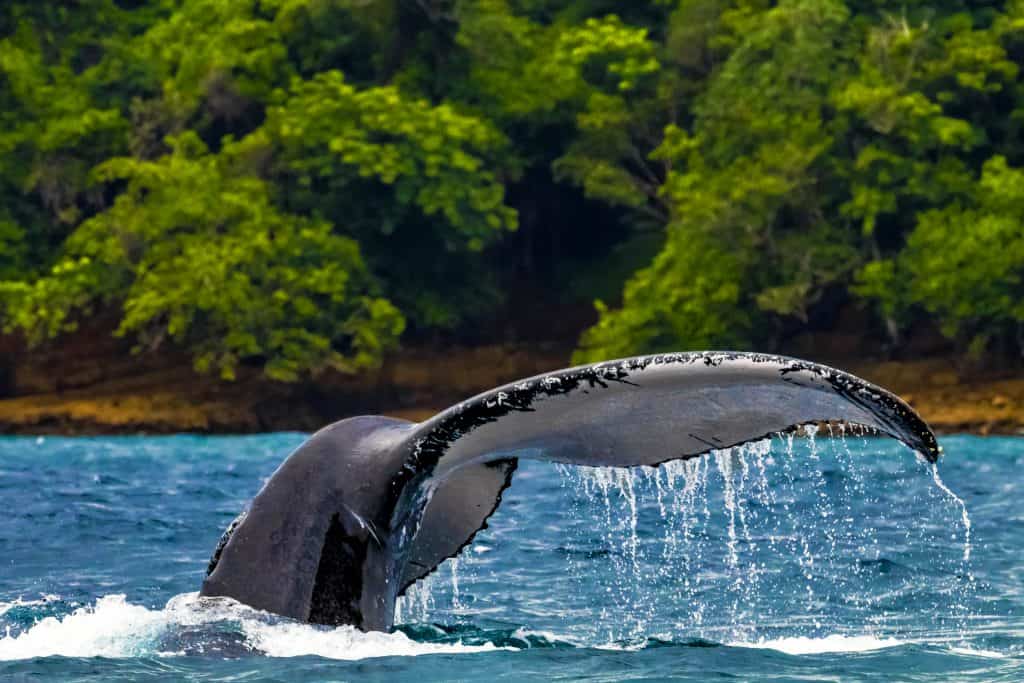
Its pectoral fins are the longest of any whale, up to a third of its body, about 5 meters each. And the tail, the fluke, can be 5.5 meters wide, wider than most of the boats that go out to see it.
3. What Do Humpback Whales Eat?
Humpback whales eat krill, tiny shrimp-like crustaceans, and small schooling fish such as anchovies, sardines and herring. In their feeding grounds, a single humpback whale can swallow up to 1,360 kg of food a day.
They also hunt as a team. Some whales blow a ring of bubbles around a school of fish, and the fish, afraid to cross that curtain, bunch up in the middle. Then the whales rise through the circle with their mouths wide open. Scientists call it bubble-net feeding.
4. Do Humpback Whales Have Teeth?
No, humpback whales have no teeth. Instead, between 270 and 400 baleen plates hang from each side of the upper jaw. They are made of keratin, the same material as your fingernails, and they work like a giant sieve.
The whale takes a huge gulp of water, its throat grooves stretching like an accordion, then pushes the water out through the baleen and keeps the food inside. So could a humpback whale swallow a person? No. Its mouth is enormous, but its throat is far too narrow for anything bigger than a small fish.
5. How Long Can a Humpback Whale Hold Its Breath?
A humpback whale usually comes up to breathe every 5 to 15 minutes, and it can stay underwater for around half an hour. Whales are mammals: they breathe air with lungs, just like us, through two blowholes on top of the head.
That tall spout is not seawater. It is warm breath full of moisture that turns into mist when it hits the air, the same as your breath on a cold morning. It can rise 3 meters, and on a quiet day you hear it before you see it.

6. Why Do Humpback Whales Breach?
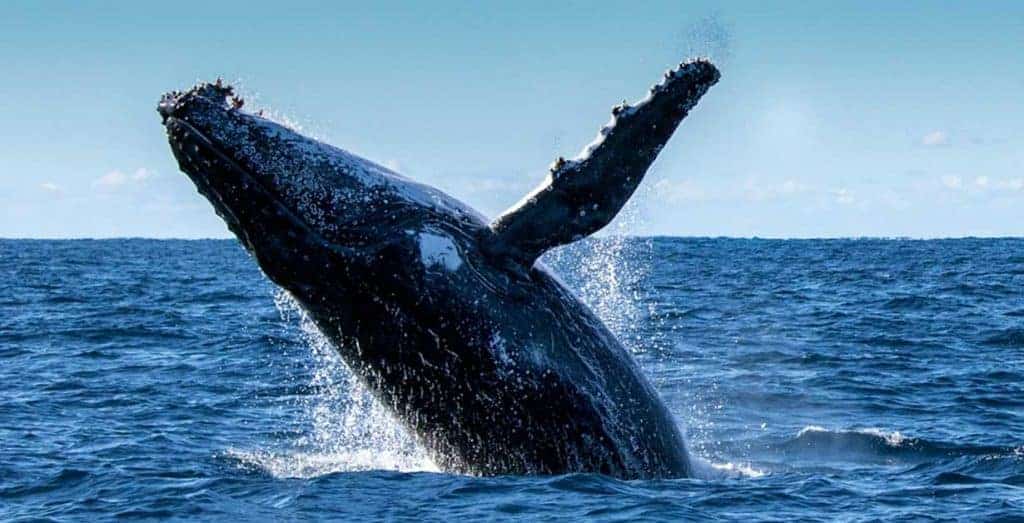
Nobody knows for sure why humpback whales breach, and that is part of the fun. Scientists think a breach may be a way to communicate over long distances, since the crash can be heard far away underwater. It may also help shake off parasites, or show off to rivals. Calves breach a lot, and many think they simply practice.

7. Why Do Humpback Whales Sing?
Male humpback whales sing, most of all in their breeding grounds, like Panama. The long, complex song is sung only by males, and scientists believe it helps attract females and deal with other males. A single song can last up to 20 minutes and be repeated for hours.
You can hear them yourself. On our whale and dolphin watching tour we carry a hydrophone, an underwater microphone. When the engine goes quiet, we drop it in the water and the song comes through the speaker. Seeing a whale is one thing; hearing it sing under your boat is something else.
8. How Do Humpback Whales Give Birth?
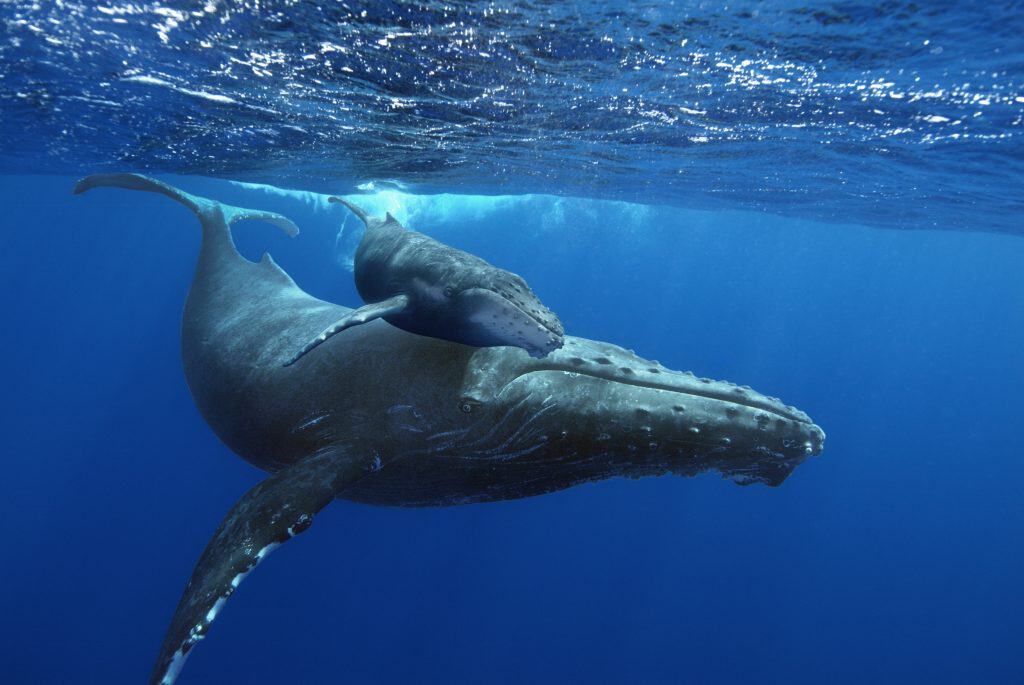
Humpback whales give birth after a pregnancy of about 11 months, and many of them do it in Panama’s warm water. The calf is born tail first and is already 4 to 4.5 meters long and close to a ton. Right after birth, the mother helps it up to the surface for its first breath.
Why come all the way to the tropics? A newborn humpback has very little fat, and it would not survive the freezing water of Antarctica. Here it can grow before the long swim south.
9. How Do Humpback Whales Feed Their Babies?
Humpback whales feed their babies milk, like every mammal. The calf nurses underwater, close to its mother’s belly, and comes up to breathe between short sessions. The milk is so rich in fat that it is thick, almost like yogurt, and the calf puts on weight every single day.
So how long do humpback whale calves stay with their mothers? About a year. The calf travels to the feeding grounds at her side, learns where to find food, and then starts its own life. Meanwhile the mother, who barely eats in Panama, can lose a big part of her body weight.
10. How Long Do Humpback Whales Live?
Humpback whales can live 80 to 90 years. Scientists estimate their age in a curious way: in the ear wax. Whales build up an ear plug in layers, one pair a year, a bit like the rings of a tree.
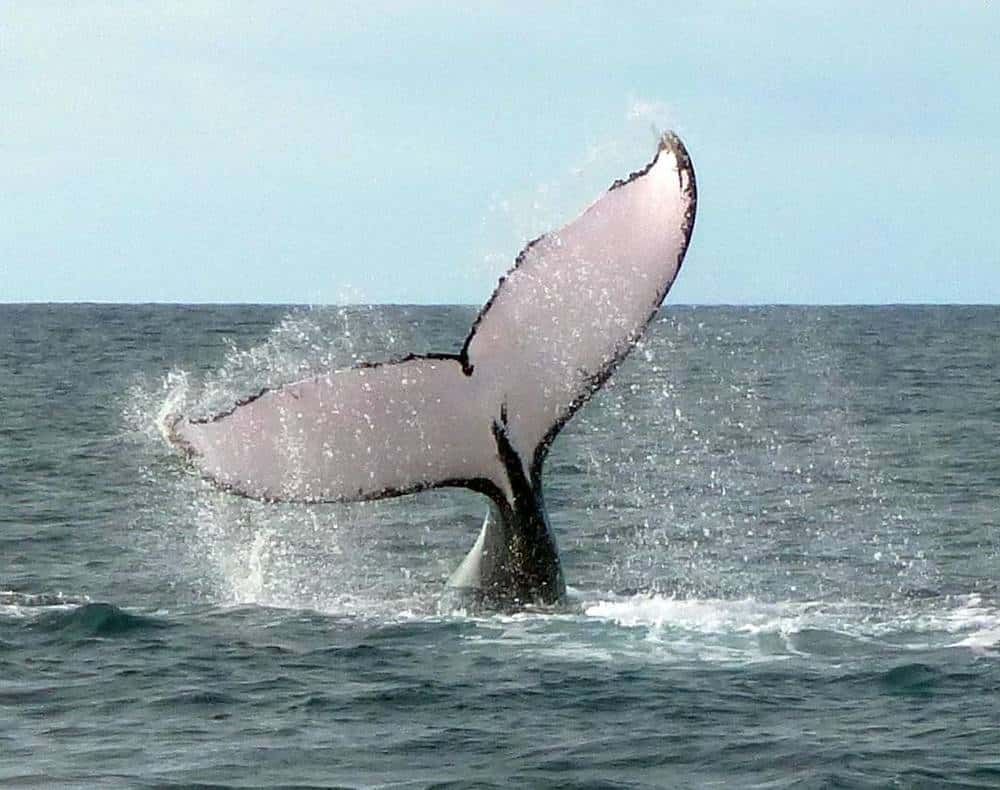
Every humpback whale also carries its own ID card: the black and white pattern under its tail is unique, like a fingerprint. Researchers use photos of those tails to follow the same whale for decades, from the feeding grounds to the waters of Panama.
11. How Fast Do Humpback Whales Swim?
Humpback whales cruise at about 5 to 15 km/h, and they can sprint to around 25 km/h when they need to. Speed is not their thing; distance is.
Every year they swim more than 8,000 km from Antarctica to Panama and back, one of the longest migrations of any mammal. We tell that story, with the map, in the route of the humpback whales.
12. Do Humpback Whales Travel in Pods?
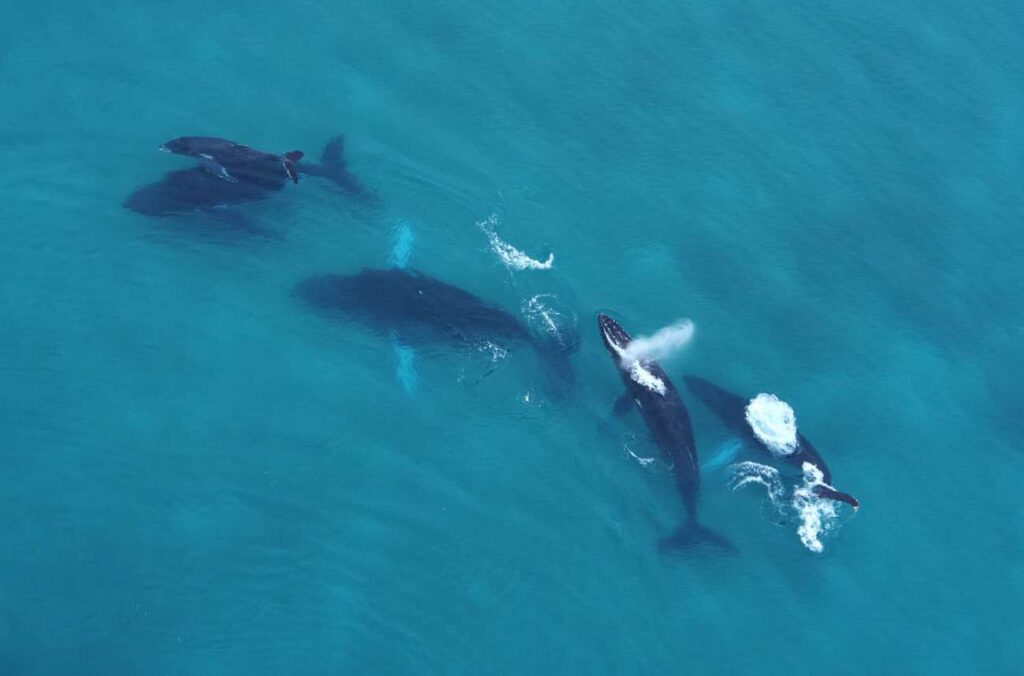
Humpback whales are not like dolphins: most of the time they travel alone or in small, loose groups of two or three that change every few hours. The closest bond is between a mother and her calf.
13. Do Humpback Whales Protect Other Animals From Orcas?
Yes, and it is one of the strangest humpback whale facts. When orcas attack, humpback whales often rush in to break up the hunt, even when the prey is not one of their own.
A study published in 2016 in Marine Mammal Science collected 115 encounters between humpbacks and hunting orcas. The humpbacks defended seals, sea lions, gray whale calves and even a sunfish. Scientists think they react to the sound of an orca attack, whoever the victim is, maybe because it could be their own calf.
14. Are Humpback Whales Dangerous to Humans?
Humpback whales are not aggressive and do not hunt people. The real risk is their size: a curious whale near a boat, or a breach close by, can cause an accident. That is why there are rules.
In Panama, boats must keep at least 250 meters from a whale, slow down and never chase or surround them. We explain all the rules in our guide to watching whales the right way. A good distance is safer for you and for the whale.
15. Are Humpback Whales Endangered?
Humpback whales are no longer endangered worldwide. Whaling wiped out more than 90% of them, but after the hunting ban of 1966 they recovered, and today the IUCN lists them as Least Concern, with about 84,000 adults.
Some populations are still in trouble, though. In the United States, the humpbacks that breed off Central America are listed as endangered. Their biggest threats today are fishing nets, ship strikes and underwater noise. That is why Panama changed the routes and speed of ships at the Canal entrances, a story you can read in our whale watching guide.

Protecting them helps all of us. Whales dive to feed and release nutrients near the surface, fertilizing the plankton that produces oxygen and absorbs carbon. A healthy ocean needs its whales.

Many of the whale photos in this post are by Eduardo Estrada. Thank you for sharing them with us.
Frequently Asked Questions
What do humpback whales eat?
Humpback whales eat krill and small schooling fish such as anchovies and sardines, up to 1,360 kg a day in their feeding grounds. During their months in tropical breeding waters like Panama, they barely eat and live off their fat.
How long do humpback whales live?
Humpback whales can live 80 to 90 years. Scientists estimate their age by counting the yearly layers in their ear wax plugs.
Are humpback whales dangerous to humans?
No. Humpback whales are not aggressive and do not hunt people. The only risk is their size, so boats in Panama must keep at least 250 meters away and never chase them.
Why do humpback whales sing?
Only male humpback whales sing the long songs, mostly in breeding areas like Panama. Scientists believe the song helps attract females and deal with rival males, and all males in a population sing the same song.
How big is a humpback whale?
An adult humpback whale is up to about 16 meters long and weighs around 30 tons, with the biggest females reaching 40 tons. Its pectoral fins can be a third of its body length.